
Most people call their dentist when something hurts. A dull ache, a sharp twinge, a sensitivity that won’t quit — pain is what pushes them to finally pick up the phone.
But here’s the problem with that logic: pain is a late warning, not an early one.
By the time a tooth starts hurting, damage has often been building for months, sometimes years. And in some cases, the tooth never warns you at all. No pain. No obvious swelling. Nothing — until your dentist takes an X-ray and tells you the tooth has to come out.
This article explains exactly why that happens. Why you might need a painless tooth extraction even when nothing feels wrong. What the actual procedure feels like. And what your options look like afterward — including how Cosmetic Dentistry Lincoln practices approach full smile restoration after dental care treatment.
The Myth: No Pain Means No Problem
This is the most common assumption patients bring into the dental chair — and it’s wrong.
Pain comes from nerves. Nerves live inside the pulp, the soft inner core of your tooth. When decay, trauma, or infection reaches that pulp, the nerve fires. You feel it. You book an appointment.
But two things can happen that cut that signal off completely.
First, decay can start in enamel — the outer layer of your tooth — where nerve endings are sparse. You won’t feel early-stage decay at all. By the time it reaches deeper layers, significant structural damage has already happened.
Second, the nerve itself can die. Once that happens, the pain stops. Not because the problem is gone — but because the alarm system is gone. The tooth is still decaying. Bacteria are still spreading. You just can’t feel any of it.
Dead teeth are genuinely dangerous because they no longer signal the presence of disease. The tooth looks normal. It doesn’t hurt. And the damage continues in silence.
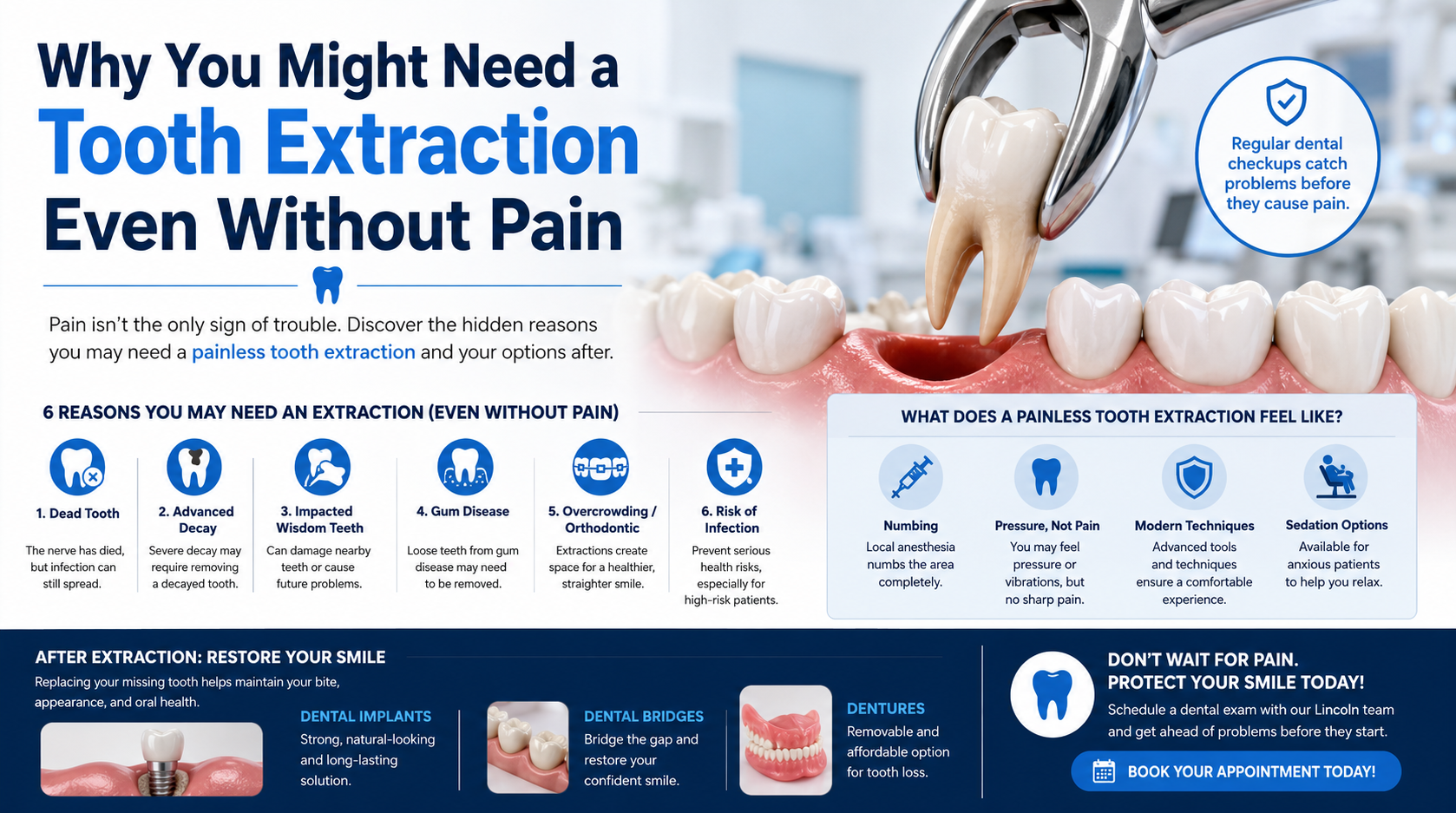
6 Reasons You May Need an Extraction Even Without Pain
1. The Nerve Has Died (Dead Tooth)
When a tooth is severely damaged — through deep decay, trauma, or repeated dental work — the blood supply to the pulp can be cut off. Without blood flow, the nerve and tissue inside die.
The result: zero pain, but zero ability to fight infection either.
A dead tooth cannot be saved with a root canal. The structure is gone. If left in place, the surrounding bone and neighboring teeth are at risk. Extraction is the only option, and the sooner it happens, the less damage spreads.
What this looks like in practice: Your tooth stopped hurting six months ago and you assumed it healed on its own. It didn’t. That “healed” tooth may now be spreading infection to the tooth next to it.
2. Advanced Tooth Decay (Removing a Decayed Tooth)
Decay doesn’t always announce itself. Early cavities sit in the enamel quietly. By the time they reach the pulp and kill the nerve, the pain that existed before simply stops.
Removing a decayed tooth at this stage isn’t a failure of dental care — it’s often the only way to stop the damage from reaching adjacent teeth. Decay spreads. A badly decayed tooth left in place is a liability for every tooth around it.
The common misconception is that if the pain went away, the cavity healed. The opposite is often true: the cavity destroyed the nerve that was causing the pain.
3. Impacted Wisdom Teeth
Impacted wisdom teeth — those trapped under the gum line or growing at an angle — are one of the most common reasons for painless teeth removal in younger adults.
They don’t always hurt. But they cause problems anyway.
An impacted wisdom tooth can press against the roots of neighboring teeth, triggering bone loss and root resorption. It creates tight spaces that are almost impossible to clean, which leads to decay in both the wisdom tooth and the one next to it. Cysts can form around impacted teeth without any symptoms at all.
If you’ve had braces or aligners, an impacted wisdom tooth can quietly undo that work over time — shifting teeth that took years to straighten.
Dentists often recommend extraction before any of this becomes painful, because by the time it does hurt, the neighboring teeth may already be damaged.
4. Gum Disease (Periodontitis)
Advanced gum disease is the single most common cause of tooth loss in adults. And it’s frequently painless.
Here’s what happens: bacteria build up along and below the gum line. The gums pull back. The bone that holds teeth in place gets eaten away. Teeth become loose. Through most of this process, patients feel nothing more than occasional sensitivity — if that.
By the time a tooth affected by severe periodontitis needs to come out, the decision isn’t about saving the tooth. It’s about stopping the bone loss from spreading further. Extraction at that point is a protective move, not a last resort.
Nearly half of adults over 30 have some form of gum disease. Many have no idea.
5. Overcrowding and Orthodontic Preparation
This one is purely preventive — no pathology, no infection, no dead nerve. Just not enough space.
Before fitting braces or clear aligners, orthodontists sometimes need to remove one or more teeth to create room for the others to shift correctly. The teeth being removed are often perfectly healthy. There’s no pain involved in the decision and typically none in the extraction either.
This is also done when a new tooth is blocked from erupting properly because existing teeth are in the way. The extraction creates a path.
6. Risk of Infection — Especially for Immunocompromised Patients
For most people, a mildly compromised tooth is manageable. For patients undergoing chemotherapy, organ transplants, or taking immune-suppressing medication, it isn’t.
A tooth that poses a low infection risk for a healthy person can become a serious threat for someone whose immune system can’t fight back. In these cases, dentists often recommend extracting even mildly compromised teeth before treatment begins — not because the tooth is causing pain, but because the risk of what happens if it gets infected is too high.
Dental infections left untreated can spread to the jaw, neck, or bloodstream. At that point it becomes a medical emergency, not a dental one.
What Does a Painless Tooth Extraction Actually Feel Like?
Fear of the procedure is the most common reason people delay dental treatment. So here’s the direct answer.
Modern tooth extractions do not hurt during the procedure. The area is numbed with a local anesthetic before anything starts. You will feel pressure. You may feel movement or vibration. But sharp pain during a properly anesthetized extraction is not normal, and if you feel it, your dentist stops and adds more anesthetic.
For patients with significant anxiety, sedation options are available — ranging from nitrous oxide (laughing gas) to oral sedation to IV sedation for complex cases.
The question of how to get a tooth out without pain really comes down to one answer: let a qualified dentist do it with proper anesthesia. That’s the method. It works. Millions of extractions happen every year with patients reporting nothing more than a feeling of pressure and some post-procedure soreness.
How to painlessly pull out a tooth is not about home remedies or tricks. It’s about going in, getting numbed properly, and trusting a procedure that has been refined for decades.
What Happens After the Extraction?
Recovery from a simple extraction is straightforward. Expect soreness for a few days. Eat soft foods for the first week. Avoid smoking, straws, and hard foods while the socket heals. Most people eat normally within a week. The extraction site heals completely within two to four weeks.
The more important question: what happens to the gap?
Leaving an empty space after extraction is not a neutral choice. When a tooth is missing, the bone underneath it stops receiving stimulation and starts to shrink. Neighboring teeth begin to tilt into the space. The tooth above or below it has nothing to bite against and starts to drift out of position.
Over months and years, a single missing tooth can change your bite, affect your jaw alignment, and alter the shape of your face.
The main replacement options are:
- Dental implants — the closest thing to a natural tooth. A titanium post is placed in the jawbone, and a crown is attached on top. It preserves bone and functions exactly like a real tooth.
- Dental bridge — a false tooth held in place by crowns on the neighboring teeth. No surgery required.
- Partial denture — a removable option, generally the most affordable but the least stable long-term.
Talk to your dentist about timing. Implants typically require a healing period of eight to twelve weeks after extraction before placement can begin.
Restoring Your Smile After Extraction — Cosmetic Dentistry Lincoln
An extraction doesn’t have to end the conversation about your smile. For patients in Lincoln, Nebraska, modern Cosmetic Dentistry Lincoln practices offer a full range of options to restore appearance and function after tooth removal.
Beyond implants and bridges, many patients use the post-extraction period as a starting point for broader smile work — whitening, veneers, or alignment correction on adjacent teeth. If a tooth had to come out, the space it leaves can sometimes be filled with a restoration that actually improves on what was there.
The right dental care plan addresses both the extraction and what comes next. Not just plugging a gap, but building a smile that holds up long-term.
If you’re in Lincoln and haven’t had a dental exam recently, don’t wait until something hurts. Book a consultation. Get current X-rays. Find out if anything is developing quietly under the surface before it becomes an emergency.
The Bottom Line
Teeth don’t always give you fair warning. The absence of pain is not a clean bill of health — it’s just an absence of pain.
Regular X-rays and checkups catch what you can’t feel. A decayed tooth, a dying nerve, an impacted wisdom tooth growing at an angle in the dark — none of these announce themselves until the damage is already significant.
Painless tooth extraction describes both the problem (you felt nothing, but the tooth still had to go) and the solution (modern dentistry makes the procedure itself comfortable).
Waiting for pain typically means a bigger procedure, a longer recovery, and more damage to the teeth around the one that needed attention in the first place.
Don’t wait for the ache. Schedule your dental exam today.
Looking for painless teeth removal or a consultation about tooth extraction in Lincoln, NE? Our team specializes in gentle, modern dental care — from extractions to full smile restoration. Contact us to book your appointment.


